
Home / Initiative
Right of Children to Free and Compulsory Education Act, 2009 Details
Right of Children to Free and Compulsory Education Act, 2009
Human Rights Education and Training
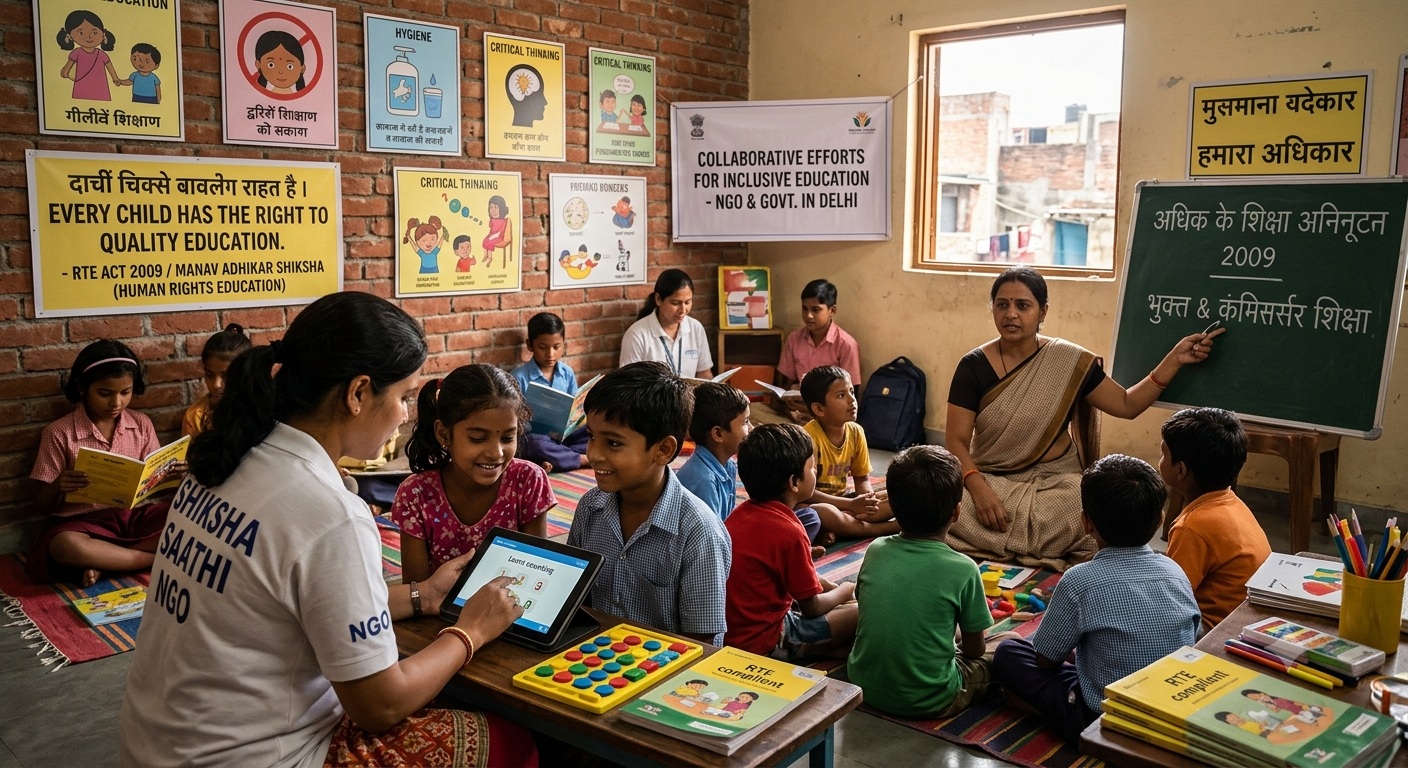
The role of education NGOs in Delhi is crucial in molding the future of a country by endowing its populace with critical thinking, information, and skill sets. It is still very difficult to guarantee that every Indian receives a top-notch education in a nation as diverse and populated as India. One of the main factors enhancing the nation's educational situation is the cooperation between NGOs and the government.
The education and NGOs in Delhi is one of the key players in the collaborative efforts needed to change the country's educational system.
Their inventiveness and focus on the community put them in a unique position to tackle the many problems the education industry faces. The best education NGO in Delhi can make a big difference in raising the standard of education throughout the nation by promoting inclusivity, strengthening teaching, and pushing for legislative improvements. The involvement of NGOs in India's quest to provide equal and high-quality education for all is indispensable.
In India, the road to development is inextricably linked to offering top-notch education to everyone. Even with the amazing progress the country has made since being independent, problems with illiteracy and unequal access to education still exist in India.
All children between the ages of six and fourteen have the legal right to free and compulsory education, as established by the historic legislation. It attempts to guarantee that it satisfies particular quality requirements in addition to its primary goal of imparting education. In formal schools, the RTE Act ensures full-time, egalitarian, and satisfactory basic education. This law acknowledges that every Indian child has a fundamental right to an education.
But even with the legal framework in place and with admirable aspirations, the actual situation frequently lags behind the desired outcomes. A survey conducted by an NGO in Delhi revealed some glaring issues. According to the poll, 42% of the seats required by the RTE Act were vacant during the 2018–2019 school year. During the poll, visits to well-known institutions revealed the harsh truth that the RTE Act's promise of free education is frequently primarily symbolic. Parents who obtain admissions through RTE are often required to incur additional costs. These expenses may include those for books, school uniforms, and, in certain cases, even a monthly food fee.
The Role of the Education NGO in India
It is an enormous task for the government of India to guarantee that every child has access to high-quality education given the country's size and variety. Organizations with a strong grassroots presence, such as NGO in Delhi, have played a significant role in increasing public awareness of the value of education. These NGO strive to give impoverished children options so they can benefit from the life-changing potential of education.
Participation and awareness in the community
Raising awareness of the value of education, especially in marginalized groups, is made possible in large part by an education NGO in Delhi. They collaborate closely with community members, parents, and local stakeholders to foster a feeling of ownership and motivate involvement in educational endeavors.
Novel approaches to instruction
Innovative teaching strategies that address a range of learning requirements are used by numerous NGOs. These techniques might be anything from interactive digital tools to experiential learning strategies, making it possible for students to acquire ideas more efficiently.
Instruction for teachers
A teacher training program might be conducted by an education NGO in Delhi to address the scarcity of qualified instructors. These courses improve teachers' educational abilities, enabling them to give their students a top-notch education.
Curriculum creation
NGOs frequently create curriculum that is relevant to the local context and reflects the goals and needs of the people they serve. This method not only guarantees that teaching is in line with students' real-world experiences but also makes learning more enjoyable.
Influence on policy and advocacy
In India, education non-governmental organizations (NGOs) are vital in pushing legislative changes that support quality and accessibility in education. Their experiences at the grassroots level allow them to offer insightful opinions for the creation of evidence-based policies.
Observation and assessment
Education non-governmental organizations frequently oversee and assess educational initiatives to guarantee their efficacy. This data-driven method aids in pinpointing areas in need of development and gradually improving tactics.
Challenges faced by a educational NGO in India
Even while Indian education NGOs have shown to be successful change agents, they are not without difficulties. Since many NGOs depend on outside financing, sustainability is an issue. Furthermore, logistical difficulties and resource limitations might make scaling up successful initiatives difficult. Gaining community trust and acceptance is essential for an education NGO in India, and it requires understanding and respecting local cultures and practices. Moreover, resources and technical know-how are needed for the collection, management, and analysis of data to assess impact.
Education NGOs have an impact outside of the classroom in a country as diverse and complex as India. They act as catalysts for social transformation, providing communities with the means to end the vicious cycle of ignorance and poverty. The education NGO in Delhi unintentionally tackles more significant societal concerns including gender equality, healthcare awareness, and skill development while striving to offer educational possibilities.
The educational nonprofit sector's success stories in India's educational system serve as a testament to the possibility of good change through teamwork. These organizations demonstrate creative models that can spur systemic improvements in addition to filling gaps. A comprehensive strategy for education reform can be accomplished by promoting collaborations between NGOs, the public and commercial sectors, and local communities. The collaboration between the NGO and the larger education ecosystem will be essential to creating a more knowledgeable, self-assured, and affluent India for future generations as the country advances toward its development goals.